Local Citations Are Still the Backbone of Local Search (Now AI Search Too)
If your business serves customers locally in a specific town, county, or region, your local search visibility hinges on more than just a good website. It depends on how consistently and widely your business is mentioned across the web.
Those mentions are called citations, and they’re just as important today as they were when we first wrote about this topic back in 2017. What’s changed is where those citations now show up and who’s reading them—including the AI tools more and more people are using to find a business.
What’s a Citation, Again?
NAP citation in Google Business Profile
A citation is any online mention of your business that includes your NAP (Name, Address, and Phone number). Citations appear on:
Directories like Yelp, Bing, Apple Maps, and Nextdoor
Industry-specific listings (for example Avvo or FindLaw for attorneys, Healthgrades or Zocdoc for medical practices, Angi or HomeAdvisor for tradespeople)
Chamber of commerce sites, local news mentions, and community organization pages
Search engines use the volume and consistency of these mentions as a trust signal. If dozens of reputable sources agree that “Adams Family Dentistry” is at the same address with the same phone number, Google has good reason to believe that information and to show you confidently in local results.
The mechanics are the same as they’ve been for several years, but a few things have shifted:
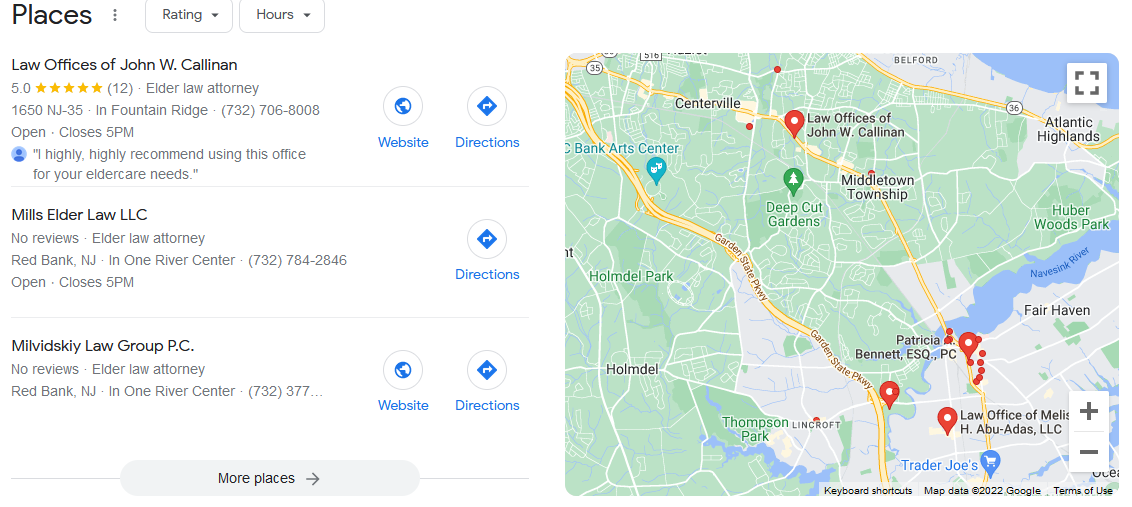
Your Google Business Profile carries even more weight. It’s important for getting listed in the Local 3-Pack — those three map listings that show up above organic results for searches like “electrician near me.” Keeping your profile complete and active (with regular posts, photos, and prompt review responses) matters more than it did a few years ago.
Google’s Local 3-Pack
Directories have consolidated. Many of the smaller citation sites from a decade ago have merged, been acquired, or shut down. That’s actually good news. It means fewer places to manage, but it also means the remaining major players (like Google, Yelp, YellowPages, Facebook, and others) carry more weight individually.
Data aggregators still feed the system. Sites like Data Axle and Foursquare distribute your business information to dozens of smaller directories and apps behind the scenes. If your info is wrong at the aggregator level, it can re-infect listings you’ve already fixed making them wrong again. This “whack-a-mole” problem is still very real. And it means you may need to frequently check to be sure your listings remain accurate.
Voice and mobile “near me” searches are now the norm, not the exception. Whether someone’s asking Siri to find an electrician or typing “personal injury lawyer near me” into their phone or web browser, the answer they get is based largely on citation data.
The New Frontier: Citations and AI-Generated Answers
Here’s the part that didn’t exist at all when I last originally wrote about thist: AI is now a front door to local search.
When someone asks Google’s AI Overviews, ChatGPT, Copilot, or a voice assistant something like “who’s a good divorce attorney near me” or “find an emergency plumber open now,” these tools don’t invent an answer from scratch. They pull from the same kind of structured, verifiable business data that’s always powered local SEO. That’s your Google Business Profile, directory citations, online reviews, and structured data (schema markup) on your website.
Here’s why that matters for your business specifically:
AI tools favor confirmed, consistent facts. AIs are cautious about recommending a business when the underlying data is contradictory. If one directory lists your business at a different address than your website does, or shows an old phone number, that inconsistency can be enough for an AI to skip you in favor of a competitor whose information checks out everywhere.
Breadth increases your odds of being “seen.” AI systems typically gather information from multiple sources rather than relying on a single listing. The more places your business appears accurately and consistently, the more chances an AI has to find your business and include it in an answer.
Structured data helps AI understand you, not just find you.Schema markup on your website (identifying things like your business type, NAP, service area, and hours, coded in a format search engines and AI can read directly) gives these tools a clean, machine-readable summary of who you are and what you do. Think of it as translating your website into a language AI can parse instantly.
Reviews increasingly double as citations. AI tools frequently reference review platforms (Google, Yelp, Facebook, Healthgrades, Avvo, etc.) not just for star ratings but for the descriptive text within reviews — what services you performed, where you’re located, and how customers describe you. Consistent NAP across those review platforms reinforces the same trust signals.
In short: the businesses most likely to get recommended by AI aren’t necessarily the biggest. They’re the ones whose information is the clearest and most consistent across the web. That’s a real opportunity for small, local businesses willing to put in the work.
A solo elder law attorney whose firm name appears three different ways online (with “LLC,” without “LLC,” and abbreviated) may find AI tools and search engines uncertain which listing is authoritative. That reduces their odds of appearing when someone searches something like “estate planning lawyer near me.”
A dental practice that moved offices two years ago but never updated its Healthgrades or Yelp listing may still show the old address in an AI-generated answer, sending patients to the wrong building. Worse yet, if the new address shows up on some directories or Google, the AI won’t have know which is the right address — and may not recommend that practice at all.
An HVAC company with accurate, matching listings across Google, Angi, Nextdoor, and its own website with proper schema markup is in a much stronger position to be the business an AI chatbot recommends when someone asks for a “furnace repair company open on weekends”.
Action Steps: What to Do Next
Audit your current citations. Search your business name, address, and phone number in Google to see what comes up. Check your listings on Google Business Profile, Yelp, Bing, Facebook, and any industry-specific directories relevant to your field. For a quick scan across several popular platforms, click here.
Fix inconsistencies immediately. Standardize your NAP exactly the same way everywhere—same abbreviations, same suite number format, same phone number. While you’re at it, make sure you fill them out as thoroughly as you can, with business hours, service area, and anything else they can show for your business.
Claim and complete your Google Business Profile. Add business hours, service areas, photos, posts, and respond to reviews regularly.
Add schema markup to your website. This helps both traditional search engines and AI tools understand your business clearly. If you’re not sure how, your web developer or SEO partner can add this for you. (At Rank Magic we have a super-easy way to do this for you.)
Prioritize industry-specific directories. For example, attorneys should focus on Avvo, Justia, Lawyers.com and FindLaw. Medical and dental practices should look on Healthgrades, AMA Doctor Finder, ADA Find-A-Dentist, and Zocdoc. Tradespeople should be listed on Angi, Houzz, Better Business Bureau, and HomeAdvisor. Those are in addition to the major general platforms.
Recheck periodically. Citation data can change as directories resynchronize with old sources. Build in a quarterly check, or use a monitoring tool.
An Easier Way: Let Us Manage It For You
Keeping citations accurate across dozens of sites while they periodically resynchronize and may revert to old data is tedious, ongoing work. That’s why Rank Magic partners with Vendastaand Yext PowerListings to offer a citation management program. We build, correct, and continuously synchronize your listings across the platforms that matter most, so your NAP stays consistent everywhere search engines and AI tools are looking.
Unlike a one-time cleanup, PowerListings locks in your information at the source, so even when a directory resynchronizes with old data, your corrected listing holds.
It’s one less thing on your plate, and it’s one of the foundations that our broader local search optimization services are built on.
If your business depends on local customers finding you — whether through a traditional search, a map listing, or an AI-generated recommendation — consistent citations aren’t optional. They’re the groundwork everything else builds on.
Just saw this on the web:
“Google search interest in “near me” has increased 34X since 20111 and nearly doubled since last year. The vast majority come from mobile—80% total.”







Just saw this on the web:
“Google search interest in “near me” has increased 34X since 20111 and nearly doubled since last year. The vast majority come from mobile—80% total.”