
Here’s a quick case study of my work with Laura Anastasia Brown, a tax lawyer in Massachusetts. It starts with a discussion of the attorney’s pain points that drove her to seek an SEO consultant, covers what we did for her, and discusses the results achieved according to Laura’s own evaluation.
Circumstances
Inadequate Traffic
Responses from Laura’s previous website were way down. She reported that the volume of calls had really decreased, and specifically that clients she considered to be a good match were not calling.
Previous SEO Consultant
Laura had received some suggestions from an SEO consultant, but thinks she didn’t follow through sufficiently. She explained that the SEO consultant would check in with her annually (!), and make some suggestions.
She said “I didn’t want to deal with it at all. Maybe if I had understood the specifics about why he was asking me to do these things, I would have paid attention. It wasn’t until I met Bill that I understood exactly what SEO was and how my website content affected my rankings. Now I pay attention!”
Lack of Visibility
The client’s website was very old and not cell phone friendly; she recognized that she needed to have it redesigned. She recognized that most clients found her from searching online and she needed to significantly increase the number who found her that way. Her goals were to have an SEO consultant work seamlessly with her web design team to achieve an increase in her business from the website.
Looking for a New Team
She wanted a brand-new team but had no idea that SEO consultants and website designers were usually separate entities. As she looked for someone new to help with her website she found the process frustrating. She complained that “No one explains what goes on behind the curtain”.
Laura felt that she went to law school, not computer school, and wasn’t interested in becoming a web design or SEO expert, but still wanted to have a general idea of what was going on.
Marketing Consultant
Laura explains that she had time during COVID to really look at her website and marketing. She interviewed a number of people about developing a new website and creating a social media presence, but nothing felt right to her. Someone referred her to Jackie Zuk at Next On Scene who she says was amazing for her social media campaign, and Jackie’s professional photos would be perfect for her new website.
Referral to SEO Consultant
Jackie referred her to Rank Magic to consult on her SEO. Laura says that “Bill conducted an SEO audit of my website with me over Zoom and I felt very comfortable with him. I especially appreciated that he explained everything about SEO to me – the who, what, where, when & why – in plain English. I finally understood what the big fuss was about SEO and why it was so important!. Bill explained his charts and analysis in plain English, and I finally understood SEO recommendations.”
Based on that, she felt comfortable hiring me as her SEO consultant.
Referral for Web Design and Hosting
Laura asked me for a reference for a new website designer, and I referred her to a few people I’ve worked with successfully. She explains “I hired Tag Online after a conversation with the owner, Amy Gideon. I figured if my SEO consultant hired them, they must be great, and they are.”
Laura has since been very pleased with them and their work.
Cautionary Warning
A previous SEO/website consultant warned her that an updated website would cause a sharp decrease in rankings and it could take a year to recover. But she felt she had to do something because her old website wasn’t doing the job. She swallowed hard and took the leap.
Actions
Keyword Research
Based on discussions with Laura, I began with keyword research, identifying the kinds of searches her potential clients were using most often. Laura took that research and after a discussion and lots of question she identified the most important search terms that she needed to show up for. Those are the ones we would optimize the appropriate pages on her website for.
Baseline Reporting
Based on that, I presented and explained a baseline report with charts representing strengths and weaknesses of the website before making any SEO changes. This included detailed keyword rankings compared with competitors, inbound link authority, and a technical site crawl outlining a number of technical coding issues for the web designer to address.
Addressing the Cautionary Warning
While the redesign was in process over at TAG Online I wanted to address Laura’s concern about the website redesign causing a severe drop in rankings, I asked them to ensure that all old URLs were permanently redirected to her new ones to retain as much as possible of the link authority they’d earned. That effort was quite successful.
On-Page Optimization Recommendations
I developed detailed written recommendations of what needed to be included or improved on the website to be optimized for the keywords Laura chose.
Some responsibilities fell to her in terms of content on the pages, and other responsibilities fell to her web designers for coding issues. I also suggested Laura add a blog to her website and add to it regularly.
Off-Page Optimization
I began working on Laura’s external local SEO by creating detailed information and
citations across several dozen local search engines, online directories, maps, mobile apps, and voice apps.
I also created listings for her on specialized niche directories, blog directories, and local directories, and recommended to Laura some directories that required her to submit herself.
Reporting
I’ve been sending Laura at least two reports a month showing her ranking progress, competitive standing among the top law firms in her practice area, traffic volume, and a number of technical website performance metrics.
She reports; “Bill makes everything so easy and he is always available for a conversation. He doesn’t just email me some computer charts and spreadsheets containing monthly results that make my eyes glaze over, like other SEO consultants. He actually cares if his clients understand and that he is meeting and exceeding their expectations. This is what I attempt to do with my own clients and it is nice to be on the receiving end.”
Results
Authority
By the end of the first year, her inbound link count had increased by 325%, improving her authority in the eyes of search engines.
Visibility
Her search traffic rose from a low of about 50 visits per month to an average of 150 visits per month.
Competing with some large Boston law firms, she’s achieved top-two rankings in Google for searches like
Massachusetts tax attorney
Massachusetts IRS lawyer
Massachusetts tax law attorney
nonprofit tax attorney in Massachusetts
and more.
Focused Traffic
She notes that blog posts have noticeably increased traffic for important focus areas of her practice without having to make wholesale changes to her website. For example, she’s looking to grow the nonprofit work she does and reports “I have noticed more emails and calls from non-profit organizations seeking tax advice, which is great.” These include charities, trade organizations, sports organizations, civic leagues, social welfare, and political organizations.
With respect to her blog, Laura writes “Like all successful business owners, I am always adjusting my business model in response to changing market conditions, e.g., Congress passing a new tax law, President Biden hiring thousands of IRS Agents and auditors, DOGE laying off thousands more at the IRS. I find that the blog allows me to change my online advertising quickly.”
Overall Client Evaluation
Increase in Business
Laura reports a very large increase in inquiries from potential clients, and nearly all of them hire her during the consultation. Laura says “Before hiring Rank Magic, I’d get my share of random calls/emails from folks that clearly didn’t need my particular services and I wondered why they were calling me, instead of another attorney. That seldom happens now.”
She says she often receives complements from clients telling her that her website shows up “everywhere”.
Media Attention
Not long after Laura’s on-page optimization was complete, she was contacted and interviewed by both the 6:00 news on WHDH Channel 7 News in Boston and quoted in an article in Massachusetts Lawyers Weekly. She attributes this media coverage as a direct result of our work.
Overall Impressions
Laura complimented me on my professionalism, my communication in plain English without jargon, and getting right to the point clearly and without confusion.
She was surprised how quickly we got her to the top of the rankings for her practice area and that we that avoided the loss of rankings that had been predicted.
She writes “I feel much better about my online presence now. TAG Online and Rank Magic have taken care of me and I am so grateful. Bill made it easy to understand what SEO is, why it’s important, and patiently answered every question I had. I had no idea it was so involved but he explained what was going on in plain English. I highly recommend him to other solo attorneys and small law firms. He is a great fit; one of his children is an attorney so he gets us. Attorneys always put their client’s needs first and their own needs way down the list. Bill made it so easy for me to get this project done. I was dreading it and putting it aside for so long. He made it pleasant with fantastic results!”
SEO is a constantly-changing field, and you can absolutely be forgiven if you find it overwhelming and complicated. Then, add onto that the sudden shift towards AI-generated answers in search engine results, and things become even more complex.
If you own a small business and have relied on SEO to grow your business traffic online, you might be tearing your hair out at now having to deal with AI as well.
But while traditional SEO and AI search are different, you can use a lot of the same fundamental principles to gain traffic from both, and if you work with an SEO agency, they can help you adapt to the trends.
Here, we’ll offer you a quick and easy guide on the differences between SEO and AI search, how you can adapt to AI, and what steps you can take to start this new optimization process!
SEO and AI Search: The Basics
For a long time, online traffic was governed by the principles of search engine optimization (SEO), a practice online businesses used to get their webpages highly-ranked for various queries on search engine results pages.
However, these days, results pages have changed dramatically as a result of the integration of AI.
Now, instead of immediately showing users the algorithm-driven results for their queries, search pages begin with AI overviews that summarize the content of the most relevant and authoritative query results. Where businesses once had to compete for top spots on results pages using SEO, they now also have to jockey for the relevance and authority that will allow them to appear in AI-generated summaries.
The process of optimizing business content for AI is now known variously as AI SEO, AI optimization (AIO), and generative engine optimization (GEO).
Key Differences Between Traditional SEO and AI SEO
Many of the core fundamentals of traditional SEO and AI SEO are similar, but there are key differences between them in terms of focus, content, and metrics.
Core Focus
The core focus of traditional SEO was to accumulate high rankings on search results pages. Various on-page and off-page strategies allowed businesses to harness their web content to attract users and gain traffic.
Good SEO, in the traditional sense, rested on how well your business could include high-volume keywords in its content, create backlinks between it and other businesses, and encourage users to stay on webpages via internal linking.
With AI search, things are different. Now, instead of targeting general keywords that might appear in search queries, content needs to be geared towards giving specific, complete answers to questions.
Because AI summaries are looking for a full answer to a user’s question, content that contains complete, authoritative information is much more likely to show up than content that is just trying to hit as many keywords as possible.
Content Style
In addition to the actual data in the content you create, AI summaries have also changed what style of content is preferred. In the past, traditional SEO favored keyword-heavy content that wasn’t necessarily brand-focused or filtered. AI engines, however, can discriminate based on brand relevance, authority, and whether content sounds genuine. As a result, AI SEO teaches businesses to shift their focus towards more informative, personalized, brand-building content like blogs, as these help communicate trust signals to AI engines.
Success Metrics
In the days of SEO dominance, most online businesses were chiefly concerned with tracking success metrics like page rankings, click-through rate, backlinks, and conversion rates. AI SEO, by contrast, has introduced new metrics that businesses can keep track of to gauge their presence in AI overviews. These new metrics include E-E-A-T (Experience, Expertise, Authoritativeness,
Trustworthiness), AI citations, mentions, and share of voice (SoV).
How Should Businesses Adapt to AI Search?
With the above differences in mind, you may be wondering exactly how you can adapt to the changes AI search has brought to SEO as a field. Here are some of our biggest tips on what you can prioritize to get your content greater AI visibility:
Focus on More Than Keywords
Instead of relying mostly on keywords, which were the core of traditional SEO, AI-optimized businesses need to focus on creating content that answers specific, long-tail questions asked by customers. It’s impossible to cover every keyword with AI in the mix, so the best bet for your business is to focus on filling your content with precise, detailed information geared towards answering one single question, which will help you accumulate and manage AI citations.
The key thing to remember with AI-optimized content is that quality matters much more than quantity. Instead of pumping out as much volume as possible, focus on refining your content to be as strong and factual as it can be.
Build Brand Authority and Connections
In the age of AI search, brand authority and connections matter more than ever. To attract AI engines, your content has to be factual and display signals of authority such as your business’ experience and expertise.
Highlighting and responding to reviews, creating partnerships and backlinks with other authoritative brands, and keeping your content consistently up-to-date is vastly more important now than ever before, as these tactics will signal to AI engines that your brand is prominent in its industry.
Work With Your SEO Agency
AI SEO can be complicated, much like traditional SEO. For business owners who aren’t tech wizards, working with SEO agencies who help us understand the fundamentals has always been a tried and tested approach. Many SEO agencies that you may already be working with are equipped with all the tools necessary to create a unique AI content strategy for your business, implement it, and then monitor its success through the metrics we discussed earlier, so sticking with them for ongoing strategy and adaptation can help you preserve continuity while also capitalizing on AI trends.
It may be an extra expense, but if you need to keep your focus on other concerns, handing the technical aspect of optimization off to specialists may actually end up making you money in the long run. If necessary, you can even supplement the ongoing work of your existing SEO agency with help from a GEO specialist who can offer some supportive and collaborative insight.
What Steps Can You Take To Capitalize on AI Search?
The tips above are general ways you can start refocusing your business towards AI optimization, but there are smaller steps you can take right now to move in the right direction. Consider these options to begin the process of AI optimization in a small way:
• Add AI-focused schema to your content: You can make small changes to your content right now to start getting mentions in AI. Add structural data elements to your content such as detailed and factual FAQs that target specific questions which AI generators can latch onto.
• Polish your technical SEO: Make sure that your website is functional and high-performing, loads fast, and is optimized for mobile devices, as these factors help AI engines crawl your website more easily.
• Leverage your local SEO tactics: To aid in citation management, layer your content, advertisements, and branding with detailed, accurate, and up-to-date information about your business, such as maps, reviews, services, and hours of operation, as these are factual details that AI loves.
Start Changing the Way Your Business Gains Traffic!
The sudden prominence of AI search may seem scary, but in reality, this new way of gaining traffic offers critical opportunities for small businesses! By employing the strategies above, you can boost your AI visibility to new levels, capitalizing on the benefits AI offers in order to foster growth.
About the Author Jason Khoo started freelancing in SEO in college, sold his first agency, and now is the founder of Zupo, an Orange County-based SEO consulting agency helping construct powerful long-term SEO strategies for our clients.
Jason also enjoys multiple cups of tea daily, hiding away on weekends, catching up on reading, and rewatching The Simpsons for the 20th time.
I almost always recommend that my SEO clients maintain an active blog on their websites. As a small business owners, they’re used to wearing multiple hats: marketing, customer service, billing, payroll — you name it. So they’re concerned about the time and attention a blog might require and want to know how important it is. They ask “Do I need a blog?”.
More important, do you need a blog?
The main concern: Time vs Value
It’s true that a blog requires time and effort. It takes a certain level of dedication to write new blog posts on a regular basis.
While opinions differ on how often you should write a new post, I typically recommend a minimum of one post per month. That may not sound too difficult, but I’ve seen several instances of clients starting a blog for their small business and posting very frequently for the first month or two, and then forgetting about it – sometimes for a year or more.
That doesn’t work.
Then why bother? Here’s why your small business needs a blog:
Boost your online visibility:
Improved visibility for your small business through effective SEO is a primary key to revenue growth.
Blogging isn’t just for lifestyle influencers. It’s a strategic move to boost your online presence.
When you consistently publish valuable content, search engines take notice.
Blog posts often automatically optimize themselves for specific, focused keyword phrases your customers may be searching for. Those “long tail” keywords often have little direct competition in search results allowing your blog post to show up near the top.
Showcase your expertise:
Google values your expertise and authority. It wants to show material from people with real Know-How.
Every bit as important as selling your products or services, you’re solving problems for your customers. Blogging allows you to showcase your expertise, share industry insights, practical tips, and success stories.
When potential clients see you as a knowledgeable guide, they’re more likely to trust you. (And by the way, that applies to search engines as well. Expertise is a ranking factor at Google.)
Connect with your audience:
Your blog helps you connect with your audience and stay connected.
Blogs tend to be less formal and more conversational than normal website pages. They help readers get to know you better and trust you. They can leave comments, ask questions about your business– and a friendly conversation follows.
People buy from people they know and trust, and your blog helps them see you as a person, not a faceless corporation.
SEO benefits:
Blogging provides fresh content that demonstrates to search engines that your small business is alive and well, that your website is being kept current, and that you’re providing valuable information and insights to your readers.
It tends to focus on those long tail keywords that are easy to rank for, and it also provides valuable internal links to other content on your website. All of that helps your blog posts and your website in general to show up higher in search results.
Use your blog to establish your local credentials.
Local Presence:
For local service area businesses, you can blog about your sponsorship of local sports teams, your support for local charity events, and build good will in the process. That also helps establish your local focus for local search results.
Marketing value:
Directories
Having an active blog allows you to be listed in a number of blog directories on the web. Each of those listings provides an authoritative link back to your blog post, which enhances the link authority of your whole website.
Email marketing
Blog posts provide great fodder for your email marketing campaign or newsletter. In fact, my Constant Contact newsletter was the main reason I started this blog way back in 2005.
Social Media
Every blog post gives you at least one new opportunity to post a link to it on all of your business’s social media accounts spreading your message further on Facebook, X (Twitter), LinkedIn, Pinterest, Instagram, Reddit, and maybe more. For my clients, I typically promote each blog post on several of the top social sites, expanding visibility beyond their own social circles.
The blog is persistent: people can discover it months/years later. Plus, links to other pages on your site remain, helping the search visibility of those pages.
Your blog can educate your target market and help you answer customer questions. I often have occasion to explain things to clients and others. Very often part of what I’m explaining has been dealt with in a blog post. So I can refer to them to that old blog post for additional information. I think I have the opportunity at least two or three times a month to send someone a pass blog post to help answer their question or explain a concept.
Your blog, over time, builds trust. It establishes your expertise and authority — both in the eyes of readers and search engines, too.
You can repurpose blog posts as structure for podcasts, webinars, or even mini e-books.
Getting started
Set realistic goals — start with a manageable posting schedule of perhaps one post per month.
Brainstorm topics — what keeps your target market awake at night? What kinds of questions do they have about what you sell or what you do? Address those.
Be yourself — don’t think of your blog like a corporate brochure. It should reflect your voice and your passions. Share stories and let your personality shine through.
Be approachable — incorporate plenty of white space, avoid dense blocks of text, wrap text around suitable images, use bullet lists. You want to avoid the dreaded TL:DR response. (Too Long; Didn’t Read) You may find some helpful suggestions along those lines in my post outlining 7 steps to a perfect blog post.
The hardest part is getting started. So jump in and get that out of the way!
What challenges have you faced with your blog? What have you found that helps? Let us know what you think about these in the comments below.
Have you found this helpful? If so, please share with the buttons on the left or the Click-to-Tweet above.
Understanding the New FTC Rule on Fake Reviews and Endorsements
As a small business owner, you might have heard about the new rule from the Federal Trade Commission (FTC) banning fake reviews and endorsements. The new rule goes into full effect in mid-October, 2024.
This rule is super important for anyone who relies on online reviews to attract customers. Let’s break it down in a way that’s easy to understand and see how it might affect your business.
What’s the New Rule About?
The FTC’s new rule is all about cracking down on fake online reviews and misleading product or service endorsements. Essentially, it aims to ensure that all reviews and endorsements you see online are genuine and not paid for or fabricated. This means no more fake five-star reviews or influencers promoting products they’ve never used.
Why Should You Care about Fake Reviews?
As a small business owner, your reputation is everything. Genuine reviews can help build trust with potential customers, while fake reviews can do the opposite. Here’s why this rule matters to you:
Trust Building: Authentic reviews help build trust with your customers.
Fair Competition: Ensures a level playing field where businesses compete based on the quality of their services, not fake reviews.
Legal Compliance: Avoid hefty fines and penalties by staying compliant with the new rule.
Key Points of the Rule
Here are some of the main aspects of the new FTC rule:
No Fake Reviews: It’s illegal to post fake online reviews or pay someone to write a fake review.
Clear Disclosures: If you’re paying someone to write a review or endorse your product, it must be clearly disclosed.
Penalties: Businesses that violate these rules can face significant fines and penalties. Fines can exceed $50,000 per violation.
Staying on the right side of this rule is easier than you might think. Here are some tips:
Encourage Genuine Reviews: Ask your happy customers to leave honest reviews.
Avoid Paying for Reviews: Don’t pay for reviews or offer incentives in exchange for positive feedback.
Be Transparent: If you’re working with influencers or reviewers, make sure they disclose their relationship with your business.
Benefits of Genuine Reviews
Genuine reviews can do wonders for your business. Here’s how:
Build Credibility: Real reviews from real customers build trust and credibility.
Improve SEO: Search engines love fresh, authentic content, which can help improve your search rankings.
Learn From Customer Insights: Honest feedback from your customers can provide valuable insights into what you’re doing right and where you can improve.
What If You’ve Used Fake Reviews?
If you’ve used fake reviews in the past, don’t panic. Here’s what you can do:
Remove Them: Take down any fake reviews from your website and ask review platforms (like Google or Yelp) to do the same.
Apologize and Move Forward: If necessary, issue a public apology and commit to using only genuine reviews moving forward.
Educate Your Team: Make sure everyone in your business understands the importance of genuine reviews and the new FTC rule.
The Bottom Line
The new FTC rule on fake reviews and endorsements is a big step towards ensuring transparency and fairness in online reviews. As a small business owner, embracing this rule can help you build a stronger, more trustworthy relationship with your customers. Remember, honesty is the best policy, and genuine reviews are worth their weight in gold.
Stay compliant, encourage honest feedback, and watch your business thrive!
If you found this helpful, please share it with the buttons on the left or the Click-To-Tweet above.
Your thoughts and opinions are welcome. Join the discussion in comments below.
Let’s explore how important online reviews are and why you should be actively monitoring and responding to them.
Online reviews are a fact of life
Like it or not, if you own a business you’re going to get online reviews. Some will be good, some will be bad, and some will fall somewhere in the middle.
Regardless of whether you do anything about them, potential customers will read them and most likely believe them. Odds are your own behavior supports that.
Customers look for reviews

Your star ranking on Google and elsewhere are seen by many potential customers. It’s critical for you to pay attention to them.
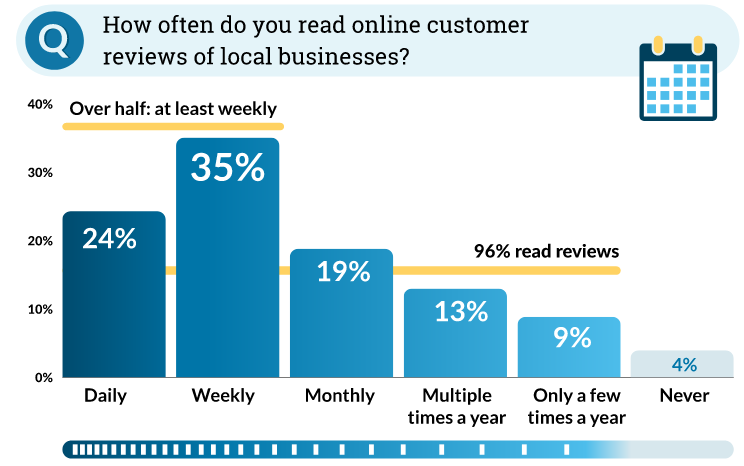
Moz recently reported that 96% of consumers read reviews at least occasionally. And BrightLocal found that 87% of consumers used Google reviews to evaluate local businesses last year.
Customers believe reviews
A survey by Website Builder found that 97% of consumers say the online reviews they read influence their purchasing decisions and 84% trust online reviews as much as recommendations from friends and family.
A survey of 8,153 U.S. consumers fielded in April 2023 reports that an astonishing 45% of consumers won’t purchase a product if there are no reviews available for it.
Search Engine Journal reported that 96% of customers look for negative reviews specifically. This figure was 85% back in 2018. That emphasizes why responding to a negative review in a positive way is so important.
You can learn from reviews

Staying aware of your online reviews can reveal weak spots in need of improvement.
Positive reviews may point out aspects of your business customers really appreciate. You can leverage that in what you stress in your social media and also your PR and advertising (if you do those things). Negative reviews can also teach you even more, pointing out things you can improve. Negative reviews also give you a chance to show off your responsiveness to customer concerns.
Moz reports that 90% of consumers are influenced by owner responses to reviews. And the above survey by BrightLocal revealed that 88% of customers are likely to use a business if they see it responds appropriately to reviews.
But most business owners are still not doing it!
Small businesses like yours are least likely to monitor and respond to reviews. Being one of the few to do this brings you two advantages:
Free advertising because you can create a favorable impression of your quality, professionalism, and customer service.
Free PR because your responses signal to others how you treat your customers.
The result of your responses is borne out by a study from Search Engine Land that showed businesses that respond to reviews convert 33% more customers than similar businesses that don’t.
We can hep automate the process for you
We can alert you every time a review shows up so you can quickly respond.
Our citation management plan not only gets you robust, perfectly consistent listings across the most important search engines, directories, maps and mobile apps, it also lets you know as soon as a new review appears for you.
That means that you can respond to those reviews immediately without having to repeatedly search across all the sites that may publish reviews about you. Think of the time that saves you!