
Here’s a quick case study of my work with Laura Anastasia Brown, a tax lawyer in Massachusetts. It starts with a discussion of the attorney’s pain points that drove her to seek an SEO consultant, covers what we did for her, and discusses the results achieved according to Laura’s own evaluation.
Circumstances
Inadequate Traffic
Responses from Laura’s previous website were way down. She reported that the volume of calls had really decreased, and specifically that clients she considered to be a good match were not calling.
Previous SEO Consultant
Laura had received some suggestions from an SEO consultant, but thinks she didn’t follow through sufficiently. She explained that the SEO consultant would check in with her annually (!), and make some suggestions.
She said “I didn’t want to deal with it at all. Maybe if I had understood the specifics about why he was asking me to do these things, I would have paid attention. It wasn’t until I met Bill that I understood exactly what SEO was and how my website content affected my rankings. Now I pay attention!”
Lack of Visibility
The client’s website was very old and not cell phone friendly; she recognized that she needed to have it redesigned. She recognized that most clients found her from searching online and she needed to significantly increase the number who found her that way. Her goals were to have an SEO consultant work seamlessly with her web design team to achieve an increase in her business from the website.
Looking for a New Team
She wanted a brand-new team but had no idea that SEO consultants and website designers were usually separate entities. As she looked for someone new to help with her website she found the process frustrating. She complained that “No one explains what goes on behind the curtain”.
Laura felt that she went to law school, not computer school, and wasn’t interested in becoming a web design or SEO expert, but still wanted to have a general idea of what was going on.
Marketing Consultant
Laura explains that she had time during COVID to really look at her website and marketing. She interviewed a number of people about developing a new website and creating a social media presence, but nothing felt right to her. Someone referred her to Jackie Zuk at Next On Scene who she says was amazing for her social media campaign, and Jackie’s professional photos would be perfect for her new website.
Referral to SEO Consultant
Jackie referred her to Rank Magic to consult on her SEO. Laura says that “Bill conducted an SEO audit of my website with me over Zoom and I felt very comfortable with him. I especially appreciated that he explained everything about SEO to me – the who, what, where, when & why – in plain English. I finally understood what the big fuss was about SEO and why it was so important!. Bill explained his charts and analysis in plain English, and I finally understood SEO recommendations.”
Based on that, she felt comfortable hiring me as her SEO consultant.
Referral for Web Design and Hosting
Laura asked me for a reference for a new website designer, and I referred her to a few people I’ve worked with successfully. She explains “I hired Tag Online after a conversation with the owner, Amy Gideon. I figured if my SEO consultant hired them, they must be great, and they are.”
Laura has since been very pleased with them and their work.
Cautionary Warning
A previous SEO/website consultant warned her that an updated website would cause a sharp decrease in rankings and it could take a year to recover. But she felt she had to do something because her old website wasn’t doing the job. She swallowed hard and took the leap.
Actions
Keyword Research
Based on discussions with Laura, I began with keyword research, identifying the kinds of searches her potential clients were using most often. Laura took that research and after a discussion and lots of question she identified the most important search terms that she needed to show up for. Those are the ones we would optimize the appropriate pages on her website for.
Baseline Reporting
Based on that, I presented and explained a baseline report with charts representing strengths and weaknesses of the website before making any SEO changes. This included detailed keyword rankings compared with competitors, inbound link authority, and a technical site crawl outlining a number of technical coding issues for the web designer to address.
Addressing the Cautionary Warning
While the redesign was in process over at TAG Online I wanted to address Laura’s concern about the website redesign causing a severe drop in rankings, I asked them to ensure that all old URLs were permanently redirected to her new ones to retain as much as possible of the link authority they’d earned. That effort was quite successful.
On-Page Optimization Recommendations
I developed detailed written recommendations of what needed to be included or improved on the website to be optimized for the keywords Laura chose.
Some responsibilities fell to her in terms of content on the pages, and other responsibilities fell to her web designers for coding issues. I also suggested Laura add a blog to her website and add to it regularly.
Off-Page Optimization
I began working on Laura’s external local SEO by creating detailed information and
citations across several dozen local search engines, online directories, maps, mobile apps, and voice apps.
I also created listings for her on specialized niche directories, blog directories, and local directories, and recommended to Laura some directories that required her to submit herself.
Reporting
I’ve been sending Laura at least two reports a month showing her ranking progress, competitive standing among the top law firms in her practice area, traffic volume, and a number of technical website performance metrics.
She reports; “Bill makes everything so easy and he is always available for a conversation. He doesn’t just email me some computer charts and spreadsheets containing monthly results that make my eyes glaze over, like other SEO consultants. He actually cares if his clients understand and that he is meeting and exceeding their expectations. This is what I attempt to do with my own clients and it is nice to be on the receiving end.”
Results
Authority
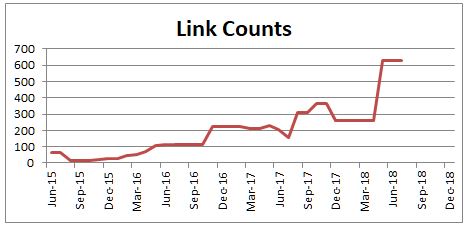
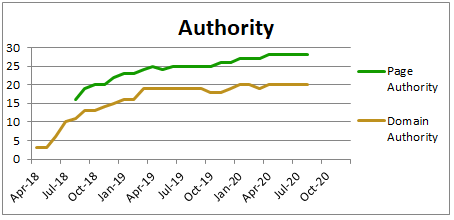
By the end of the first year, her inbound link count had increased by 325%, improving her authority in the eyes of search engines.
Visibility
Her search traffic rose from a low of about 50 visits per month to an average of 150 visits per month.
Competing with some large Boston law firms, she’s achieved top-two rankings in Google for searches like
Massachusetts tax attorney
Massachusetts IRS lawyer
Massachusetts tax law attorney
nonprofit tax attorney in Massachusetts
and more.
Focused Traffic
She notes that blog posts have noticeably increased traffic for important focus areas of her practice without having to make wholesale changes to her website. For example, she’s looking to grow the nonprofit work she does and reports “I have noticed more emails and calls from non-profit organizations seeking tax advice, which is great.” These include charities, trade organizations, sports organizations, civic leagues, social welfare, and political organizations.
With respect to her blog, Laura writes “Like all successful business owners, I am always adjusting my business model in response to changing market conditions, e.g., Congress passing a new tax law, President Biden hiring thousands of IRS Agents and auditors, DOGE laying off thousands more at the IRS. I find that the blog allows me to change my online advertising quickly.”
Overall Client Evaluation
Increase in Business
Laura reports a very large increase in inquiries from potential clients, and nearly all of them hire her during the consultation. Laura says “Before hiring Rank Magic, I’d get my share of random calls/emails from folks that clearly didn’t need my particular services and I wondered why they were calling me, instead of another attorney. That seldom happens now.”
She says she often receives complements from clients telling her that her website shows up “everywhere”.
Media Attention
Not long after Laura’s on-page optimization was complete, she was contacted and interviewed by both the 6:00 news on WHDH Channel 7 News in Boston and quoted in an article in Massachusetts Lawyers Weekly. She attributes this media coverage as a direct result of our work.
Overall Impressions
Laura complimented me on my professionalism, my communication in plain English without jargon, and getting right to the point clearly and without confusion.
She was surprised how quickly we got her to the top of the rankings for her practice area and that we that avoided the loss of rankings that had been predicted.
She writes “I feel much better about my online presence now. TAG Online and Rank Magic have taken care of me and I am so grateful. Bill made it easy to understand what SEO is, why it’s important, and patiently answered every question I had. I had no idea it was so involved but he explained what was going on in plain English. I highly recommend him to other solo attorneys and small law firms. He is a great fit; one of his children is an attorney so he gets us. Attorneys always put their client’s needs first and their own needs way down the list. Bill made it so easy for me to get this project done. I was dreading it and putting it aside for so long. He made it pleasant with fantastic results!”
Understanding the New FTC Rule on Fake Reviews and Endorsements
As a small business owner, you might have heard about the new rule from the Federal Trade Commission (FTC) banning fake reviews and endorsements. The new rule goes into full effect in mid-October, 2024.
This rule is super important for anyone who relies on online reviews to attract customers. Let’s break it down in a way that’s easy to understand and see how it might affect your business.
What’s the New Rule About?
The FTC’s new rule is all about cracking down on fake online reviews and misleading product or service endorsements. Essentially, it aims to ensure that all reviews and endorsements you see online are genuine and not paid for or fabricated. This means no more fake five-star reviews or influencers promoting products they’ve never used.
Why Should You Care about Fake Reviews?
As a small business owner, your reputation is everything. Genuine reviews can help build trust with potential customers, while fake reviews can do the opposite. Here’s why this rule matters to you:
Trust Building: Authentic reviews help build trust with your customers.
Fair Competition: Ensures a level playing field where businesses compete based on the quality of their services, not fake reviews.
Legal Compliance: Avoid hefty fines and penalties by staying compliant with the new rule.
Key Points of the Rule
Here are some of the main aspects of the new FTC rule:
No Fake Reviews: It’s illegal to post fake online reviews or pay someone to write a fake review.
Clear Disclosures: If you’re paying someone to write a review or endorse your product, it must be clearly disclosed.
Penalties: Businesses that violate these rules can face significant fines and penalties. Fines can exceed $50,000 per violation.
Staying on the right side of this rule is easier than you might think. Here are some tips:
Encourage Genuine Reviews: Ask your happy customers to leave honest reviews.
Avoid Paying for Reviews: Don’t pay for reviews or offer incentives in exchange for positive feedback.
Be Transparent: If you’re working with influencers or reviewers, make sure they disclose their relationship with your business.
Benefits of Genuine Reviews
Genuine reviews can do wonders for your business. Here’s how:
Build Credibility: Real reviews from real customers build trust and credibility.
Improve SEO: Search engines love fresh, authentic content, which can help improve your search rankings.
Learn From Customer Insights: Honest feedback from your customers can provide valuable insights into what you’re doing right and where you can improve.
What If You’ve Used Fake Reviews?
If you’ve used fake reviews in the past, don’t panic. Here’s what you can do:
Remove Them: Take down any fake reviews from your website and ask review platforms (like Google or Yelp) to do the same.
Apologize and Move Forward: If necessary, issue a public apology and commit to using only genuine reviews moving forward.
Educate Your Team: Make sure everyone in your business understands the importance of genuine reviews and the new FTC rule.
The Bottom Line
The new FTC rule on fake reviews and endorsements is a big step towards ensuring transparency and fairness in online reviews. As a small business owner, embracing this rule can help you build a stronger, more trustworthy relationship with your customers. Remember, honesty is the best policy, and genuine reviews are worth their weight in gold.
Stay compliant, encourage honest feedback, and watch your business thrive!
If you found this helpful, please share it with the buttons on the left or the Click-To-Tweet above.
Your thoughts and opinions are welcome. Join the discussion in comments below.
Do online reviews matter? I get a lot of questions about online reviews, both from clients and others.
Often I’m asked whether online reviews matter at all.
Sometimes people wonder if customers are likely to write reviews for them.
And whether review readers trust them.
And if asking for reviews can hurt them.
Or whether asking for reviews might encourage negative reviews.
I thought it was time to put together kind of an FAQ about some of the most frequent online review questions I hear.
How important are reviews for my small business?

Reviews can be very important for a local small business. Three important reasons are:
People do read reviews.
Not only do they read them, but they trust them.
Reviews can be an important search ranking signal, helping move you up (or down) in search results.
Do customers really read reviews?
Moz recently conducted a study that revealed a full 96% read reviews, at least occasionally. In fact, more than half of people read online reviews at least weekly! If half of your potential customers are reading your reviews, obviously that makes your reviews pretty important.
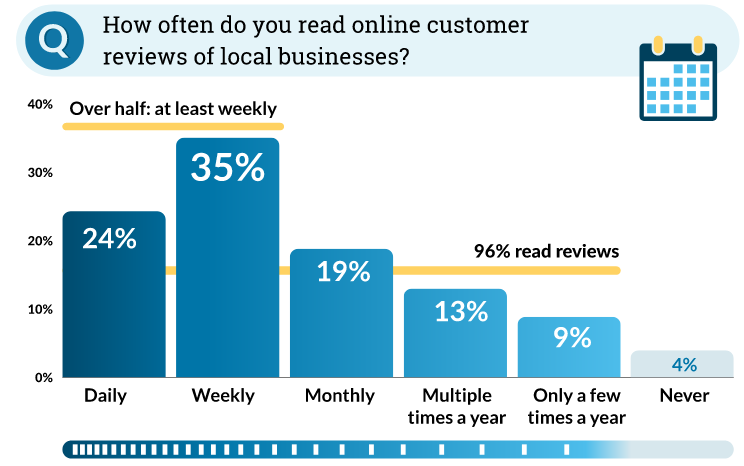
From the Moz study of online review behavior.
Do people trust reviews?
Do online reviews matter if people don’t trust them? I’ve been asked that by some skeptical business owners. But people do trust them! 86% of people consider reviews at least somewhat important when considering a business. And fully a third of consumers consider reviews to be the single most important factor when deciding whether to patronize a business. Another study showed that 58% of customers would pay more or travel further to deal with a company with good reviews.
A survey by Website Builder found that 97% of consumers say the online reviews they read influence their purchasing decisions and 84% trust online reviews as much as recommendations from friends and family.
How many reviews do I need?
Opinions on this are all over the map. Some sources say you need at least five reviews to show up. Others say you need at least 100 reviews to be trusted. But a lot depends on the size of your company and your scope.
A national eCommerce brand needs more reviews than a local store or business. My advice is to check your competitors that are showing up on the first page or two of Google and target more reviews than they have.
Most sites that collect reviews display your average star rating. Almost all are on a scale of 1 to 5 stars. The sweet spot seems to be somewhere between 4.2 and 4.8 stars. That’s because some consumers are suspicious of a straight five-star rating, thinking that perhaps the business is supporting fake reviews. In fact, Yelp found that more than 70% of people would avoid a business if they thought the business had fake reviews or was offering compensation for good reviews. On the other hand, anything less than 3 stars is probably no giving anyone much confidence in your business.
What percentage of customers write reviews?

Moz found that only 14% of customers never write reviews. In fact, more than 40% write reviews at least once a month. So don’t be shy about asking your customers to write reviews for you. Many of them will be happy to do so.
Website Builder found that 5-10% of customers typically write reviews. Presumably those are customers who’ve not been explicitly asked to write a review. Other studies have found that up to 72% of customers will write a review if they are asked to do so.
How can I get more online reviews for my small business?

If online reviews matter for your business, you obviously want more of them. And the good news is that If asked, more than half of your customers will usually write a review.
The top reason customers don’t review your business is because they forget to, not because they don’t want to. So it’s a good idea to follow up if they haven’t written a requested review within a week .
But don’t try to game the system. Half of consumers lose trust if it looks like owners or employees are reviewing their own business. And many review sites use semantic analysis to identify such self-serving reviews and weed them out.
Which review site is best for a local small business?

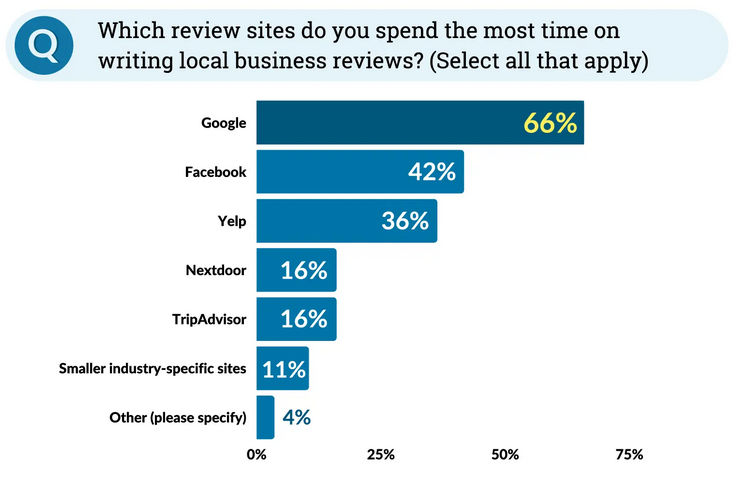
People tend to read (and write!) more reviews on Google than anywhere else. Online reviews matter the most on Google as a result. So that’s where you should focus mostly. But not entirely, because other review sites get a fair amount of exposure, too.
Should I ask only for Google reviews?
Absolutely not.
When someone receives a word of mouth referral to you, they almost always look you up online before reaching out to you. Your Google Knowledge Card ought to show up, and your website, of course.
But other sites will show up too, like Facebook, Yelp, Better Business Bureau, YellowPages, Judy’s Book, and others. When they do, you want gold review stars there. The gold color makes the review stars very noticeable, and the more good review stars people see on other sites for you, the more likely they are to trust you.
I’ve seen reports that 90% of people are influenced to at least a a moderate by owner responses to reviews. Also, a survey shows that 63% of consumers will update their negative review or low-star rating once an owner responds to resolve their complaint.
What if I get a bad online review?

An occasional negative review is inevitable. Admittedly, they’re disappointing to see, and you can’t be blamed for wanting to get rid of it. In most cases, you probably shouldn’t try. If it’s clearly a bogus review left by a competitor to hurt you or it seems the reviewer intended the review for another business entirely, then you might seek removal.
But a legitimate negative review is an opportunity for you. First it may alert you to something you can improve about your business. and second, it gives you an opportunity to respond — and you should do that quickly. Expressing appreciation for the feedback and demonstrating a willingness to fix whatever went wrong may get the reviewer to revise their review. Even if not, it will reassure readers of your good intentions.
On the flip side, a defensive tone in a review response is likely to make things worse. So always stay positive.
Are reviews only good for search traffic?

No! They’re a great way to find out what consumers think you’re doing right and where you can improve.
That only works if you read them, of course. But you should be doing that anyway so you can respond to them.
Treating all reviews as constructive criticism is key to benefiting from them in terms of how you run your business. And when you respond with appreciation for the constructive feedback, that a less than perfectly positive review create a positive impression in anyone reading it.

So really — do online reviews matter? Absolutely!
We welcome your perspective on this in the Comments section below.
And if you found this helpful, please share it with the buttons on the left or the Click-to-Tweet above.
There’s no magic bullet to improving your visibility or ranking on Google. No single technique switches you from not found to dominating the search results. Google rankings depend on a combination of many things, but some are more important than others. Here are the top 10 ways you can improve your Google rankings:
Write great content
Optimize that content
Improve your authority with backlinks
Improve user experience
Use H1 and H2 heading tags
Optimize your images
Improve your page speed
Optimize for voice search
Fix technical issues
Local SEO
How to improve your Google rankings: the details
A list of items to address is fine, but what do all those things mean? And how do you do them? Let’s explore them here.
1. Write great content
Each page or blog post on your website has a goal of encouraging the reader to take an action. That might be to buy a product, to call to ask questions, to subscribe to your newsletter, or something else.
But each user comes to your page or blog post with their own intent. They may be looking for an explanation of something, do-it-yourself instructions, or to see if you sell something or offer a service they need. Failure to address that user intent will reduce your conversions and hurt your search rankings.
Your content needs to be laser-focused on pretty much a single concept. if you try to cover too many things on one page, that page will not be “all about” any of them.
Speaking of focus, it’s important to concentrate on benefits rather than features. A page that describes all of the features of your product or service is not nearly as effective a marketing tool as a page that describes the benefits your reader will derive from it. Here’s a handy tool to help you understand how customer-focused your content is.
Helpful and informative content that is too difficult to read won’t accomplish its goal. It’ll drive visitors away. Be careful to make sure your reading level is no higher than the 8th-grade level. That doesn’t mean you need to dumb it down. But try not to use too many long, multi-syllabic words. Keep your sentences relatively short (fewer than 20 words). And break up your paragraphs to avoid using the impression that your content is too dense.
Keywords potential customers search with need to be the focus of your content.
2. Optimize that content
If you’re writing material you want to show up in searches, you need to think about how people will search for it. Those search phrases are keywords, and your article needs to maintain a focus on those keywords throughout.
You want to have your keyword phrases (or close variations on them) in headings and subheadings, in paragraph text, in link text, and even in image filenames and alternate text.
It can be a powerful technique to link to other resources within your website to expand on what you’re writing about. Search engines also recognize outbound links to authoritative material as providing additional value to your readers. That can help improve your Google rankings.
Continued growth in backlinks shows that people continue to find your information useful.
Your website’s authority, based on the number and quality of links from other websites, is a critical ranking factor at Google. Inbound links need to be both authoritative and relevant to your site or web page.
If you’re a local or service-area business, local links have high relevance, even if they’re from businesses quite different from yours. And citations which list your NAP (name, address, and phone) — and often a link — on local search engines, directories, maps, and mobile apps can help improve your Google rankings in local searches. We offer affordable local search citation management services to our clients.
Google released a major algorithm change last year, called the Page Experience update. If users find your website annoying, not only will they leave quickly but it will also reduce your rankings.
Your website needs to be responsive to the device looking at your site, often referred to as being mobile-friendly. That relates not just to the appearance and usability of your site on a phone, but also to the download speed (phones tend to be slower than desktop computers).
Sufficient white space makes your content more approachable and less intimidating than a very dense-looking page. Avoid the TL:DR syndrome. You can also include images with text wrapping around them to make the page appear less dense. Avoid annoying popups that obliterate content or delay the loading of a page. Do whatever you can to make your page friendly and easy to read
5. Use heading tags
Employ subheadings because people tend not to read web pages, but scan them. Subheadings help the reader find and focus their attention on what they need. Identify them as headings or subheadings with heading tags in the code so search engines understand what they are. Words enclosed in heading tags are considered more important by search engines.
6. Optimize images
Images on your pages can be optimized for both speed and keyword placement to improve your Google rankings.
To make sure your images download as quickly as possible, make sure to size them properly before uploading them to your web page. If you upload an image larger than you want it to appear on the page, all of the pixels of that larger image need to download before the browser can shrink it down to size. And all that takes time. Shrinking your images before you upload them can very significantly reduce the number of pixels to download, speeding up your page display.
To optimize your images for keyword phrases, there are a few places to do that.
Use a keyword in the file name of the image. A file name of blue-widgets.jpg is much more helpful to search engines than the file name of IMG418.jpg. If you have multiple words in your file name, separate them with hyphens rather than underscore characters. That’s because search engines understand hyphens (but not necessarily underscores) as separating words.
Describe the image in the alternate text, including a keyword phrase for the page can.
If the image is clickable and links to someplace else, you should give it a title tag. When the user hovers their mouse above the image, the title tag will pop up in a small text box to tell the user where it will send them when they click. You can put keyword phrases in here, too.
7. Improve page speed
Faster pages provide better page experience, which helps your rankings.
Page speed has been getting more attention since the Google Page Experience update in the summer of 2021. How quickly your pages download into a browser translates into a better or worse customer experience. And that’s directly related to how many customers stay on your page waiting for it to load, as opposed to returning to the Google search results and finding someone else.
If most visitors to your website come from their mobile devices (you can find that out in your Google Analytics) then your mobile speed may be more important than your desktop speed. Sadly, mobile download speed is seldom as quick as desktop speed.
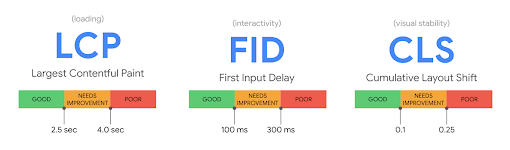
Google is looking very carefully at what it refers to as Core Web Vitals. They relate to page speed, ease of interaction, and the visual stability of the page. These can get pretty technical, and most readers will want to defer to their web designer or web programmer for dealing with them.
8. Optimize for voice search
Mobile phones now constitute more than 60% of all searches. And the majority of those mobile searches are done by voice through Google or Siri rather than keyboarding.
Voice searches tend to be different from typed searches. For one thing, they tend to be longer and more conversational. Your web content needs to adapt accordingly.
Technical issues on your site can cause problems for your visitors, but more often they interfere with search engines crawling and indexing your website. And if they can’t crawl or index your site, you can’t show up in search results. Here are a few things that can cause you trouble. Fixing them can improve your Google rankings.
Broken links are those that result in a “404 Page Not Found” error. those may be links to discontinued pages on your website or to pages on an external site that have been changed, moved, or deleted. An occasional broken link is pretty normal, but if your website has too many of them that can be a problem.
Server errors occur when the web hosting server is unable to display the requested page. When monitoring tools are reporting server errors that you can’t replicate manually, that usually means there’s nothing wrong with your website. Instead, the web server was too slow. Shared web servers can have many websites on them, and if they’re overloaded they can slow down or be unable to deliver a web page. If that’s happening to you, it’s time to ask your web hosting company to move you to a less crowded or faster server. If that doesn’t work, you may need to change your web hosting provider.
When a page moves to a new URL or is deleted, it’s important to properly redirect that URL to its new location or the closest matching page on your site. Redirect chains occur when page A has been redirected the page B, but then page B redirects to another page C. These can slow down search engine spiders and cause some pages on your website to be overlooked.
Duplicate content can get you filtered out of search results.
If the search engines think that multiple pages on your website contain essentially duplicate content, some of those pages are unlikely to show up in search results. Pages that have relatively thin content often trigger the duplicate content flag. These are pages where the unique content on the page is relatively small compared to all of the common content that exists on many pages (headers, footers, logos, and so forth). The remedy for that is to expand the content on those pages so they are clearly different from one another.
Page titles and meta tag issues are quite common. Duplicate page titles and meta description tags interfere with one another in search engine indexing. Missing page titles and descriptions are probably even worse. We also see page titles and descriptions that are either too short to be effective or too long. It’s good to have a tool that can monitor your website and alert you to any of these conditions. We use Moz to detect and report on these for our clients.
10. Local SEO (if appropriate)
If your business has a brick-and-mortar location or serves customers in a geographical area, you’ll benefit from Local SEO. eCommerce sites or those that serve customers nationwide may not need it.
If you do need local SEO, here are the main items that need your attention.
On-page mentions of your service area, whether it’s a whole state, counties, or cities and towns. A separate page itemizing your service area is not very effective in helping your other pages show up in local searches.
A robust Google Business Profile is essential. And when you create it, fill out as much information about your business as it allows.
Structured data markup in accordance with schema.org should be in place on every page with at least your NAP. Expanding it with business hours and other information about your pages helps as well.
Citations are mentions of your business with your NAP and other information. You need to be widely listed on many sites across the web with consistent information about your business. The more local search engines, directories, maps, and mobile apps that list you, the better – as long as the information on them is consistent across the board. You can check how well your citations are doing with our free citation scan.
Local PR is another excellent tool to cement your local presence. If you sponsor local activities and support local charities they may have the opportunity to mention that online. It’s also helpful if your business can receive a mention in a local newspaper article or hyperlocal news website story. And of course if these mentions can include a link back to your website, that’s just icing on the cake.
Final thoughts
If you’re lucky, you may only need to work on a few of the above areas. I encourage you to evaluate your website in each of those areas and focus your attention on the ones most in need of improvement.
As a small business owner, you don’t have to let big business walk all over you. Take advantage of SEO.
Understanding the basics of small business SEO can help your visibility, not to mention your bottom line.
Small businesses make up over 99% of the business sector in the United States. Due to the intense competition associated with this statistic, the chances of businesses making it past the one-year mark are very slim if they don’t utilize online marketing and advertising.
Even if your customer base is purely local, those current and potential customers rely on online information that either includes you in their customer journey or rules you out in just a few seconds.
From making decisions on where to eat for dinner, where to get their dog groomed, or what yoga studio to join, a single Google search can make or break your business.
When compounded over time, failure to catch the eye of these potential customers can seriously impact your bottom line, especially if your site is not located on the first page of search engine result pages (SERPs).
If you run a relatively new company, or if you’re in the process of starting one and want to make sure you are set up for success at the start, it’s important to understand why SEO is important for your small business.
Keep reading to get an idea of the basics of small business SEO and how it can help you grow your business.
What Is SEO?
SEO (Search Engine Optimization) is the process of creating digital content or web pages that are easily found by search engines as they crawl for keywords within the content. They then match these keywords with searches made by their users. Not only does this have to be an accurate match to the user’s query, but it has to be a relevant one.
Search engines like Google pride themselves in weeding out low-quality content that users don’t want to see; which means what we might consider little things like old content or poor spelling could be keeping your site from ranking!
There are many (admittedly confusing!) ranking factors that go into the special SEO sauce Google likes and rewards sites for implementing by giving them higher SERP ratings.
In the past — and even now — keywords have been a huge focus in SEO practice. Still, it’s become apparent in recent years that Google places a higher value on the reader’s experience after clicking “search” over the keywords found in a piece of content. Make sure every piece you and your team produce, whether it’s a blog post, a landing page, or a product description, is high-quality.
Here are some SEO practices that Google “likes”:
Original Content. This seems like a no-brainer, but if they find something that matches word for word on another site, they will pick up on the fact that you’ve either intentionally or unintentionally plagiarized someone else’s content.
Quality connections to other sites via link-building. By obtaining backlinks, you can increase your authority as Google sees other sites referring to your page as a valuable resource.
Quick load. If a site isn’t providing users with a pleasant experience, no one will want to visit it, and Google won’t recommend it!
Keywords are seamlessly included in the content that is purely there to help answer a user’s query. No keyword stuffing!
It’s important to provide the most relevant and comprehensive answer to a question or solution to a problem that your customer is looking for. By consistently producing high-quality content, your site can stand out from the competition both on SERPs and in the customer’s search journey.
Simply put, a business must focus on SEO optimization because competitors are already doing so — and they will continue to do so.
In the past, brick-and-mortar locations relied on word-of-mouth, print ads, radio spots, or even local TV commercials to make up the bulk of their advertising. These methods worked because they were meeting their customers where they were. Years ago, potential customers could be reached while they were reading a paper, listening to local radio, or watching local TV. But these marketing methods are fading into the background as most people access all the information and entertainment they want online via websites, podcasts, and social media.
Local SEO brings customers right to your door.
Focusing on SEO helps you meet your customers where they are now.
Start by running a competitor analysis to shed light on competitors you were previously unaware of. These businesses either are or could in the future direct potential customers away from your website before they even find the address where you do business!
By putting local search optimization in place as you start, you can find gaps where you might want to gather and include reviews, include consistent business hours, offer more robust product and service descriptions, and more!
Keeping all of this up-to-date ensures customers see you as a desirable option versus a site that hasn’t been updated in months with out-of-date photos or old reviews.
What Can It Do For Me?
Name a struggle your business currently faces, and you’ll probably find a solution that SEO brings to the table! If your business is new and doesn’t have the credibility other competitors have, putting the work into SEO can yield results over time. You’ll build not only your site’s visibility on SERPs, but also in comparison to other businesses as you surpass them in rankings.
As your rankings improve, your traffic and engagement will increase as well, resulting in a higher conversion rate (the percentage of people who take the desired action, whether that be making a purchase or subscribing to a service).
In general, SEO helps your business not only survive but grow over time, whereas other (paid) marketing methods may only yield temporary results.
How Do I Get It?
SEO is probably not as expensive as you fear.
We know it’s hard for small business owners to make sure no aspect of their business gets neglected, but it happens. Either time or budget limitations can limit or even cut SEO from the day-to-day operations of a company. However, ignoring SEO optimization can seriously hinder your business from thriving.
If your budget is tight but you have some time to devote to learning and implementing new tactics, look into using a free program, or purchasing an SEO tool that does the heavy lifting for you.
Often, small businesses find themselves in a situation where they’re not able to hire someone full-time but want to bring a professional in to set things up and enable easy maintenance of their SEO campaigns themselves later on. Budgets can limit how long a consultant works on your site, thus limiting the effectiveness of your SEO optimization. To keep cash on hand, consider applying for a small business loan, or a business line of credit that provides the means for hiring SEO professionals for the scope of work you need.
An attractive aspect of SEO is that the upfront investment in hiring, setup, and maintenance isn’t as costly as paid advertising that may or may not work. SEO plays the long game by gaining traffic and visibility organically; which means what’s put in place today can yield results months or even years in the future as you maintain your site and continue to put out great content and resources.
What Can I Expect?
Once you optimize your site with SEO, results can continue to grow for years.
Set your expectations appropriately. SEO isn’t a quick fix or band-aid to immediately stop the loss of customers when a competitor shows up.
If your business is just starting out, devote a sizable portion of your budget to a related company role, or tools for SEO. Positive outcomes from your SEO practices may not show up as quickly as you want them to, but they are much more sustainable than purchasing hundreds of ads on one platform.
Find an SEO checklist and work on it with your consultant or designated in-house digital marketing personnel to ensure you set things up correctly at the beginning and keep everyone on the same page. We cannot stress enough that giving things the appropriate amount of time to yield results is crucial when measuring the success of implementing or re-working your SEO methods.
Many business owners get frustrated when they don’t see exponential growth within a few weeks of starting their practices and assume their SEO teams are doing things wrong. This assumption is often very far from the truth! When in doubt, keep the lines of communication open, and adjust your expectations according to the information your teams provide.
Don’t Wait!
Your small business can greatly benefit from the basics of small business SEO by creating high-caliber content, optimizing your site for local searches, and seeking to be a resource for customers – both in person and online. It takes time and dedication, but you will see measurable success over time that can ensure your small business is around for years to come.
We value your opinions! Let us know what you think of this in the comments below.
Share this information with other business owners on your social media — just click on the square Follow buttons on the left or the handy Tweet link above.